
By Nathan MacLennan, SGSAH Doctoral Intern
Argyll Estates Archives would like to thank the generosity of the Friends of Argyll Estates Archives in allowing us to make this wonderful acquisition to our collection. Your support goes a long way in helping us to preserve the legacy of the Campbell family and estate.
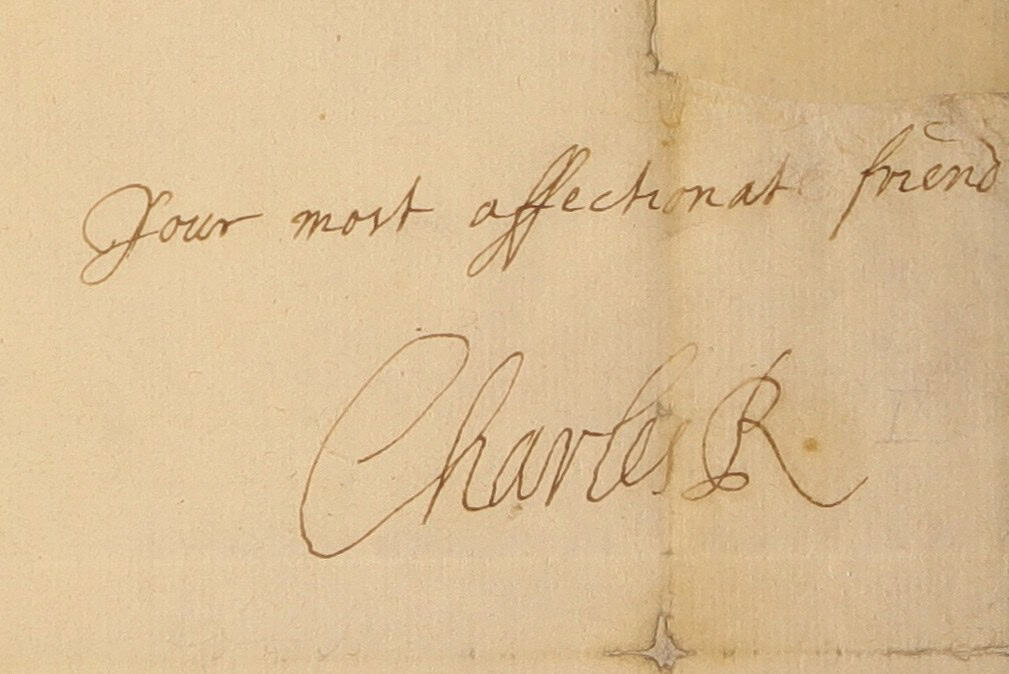
The archives were lucky enough to acquire a new item at auction. A letter from King Charles II addressed to Archibald Campbell, 1st Marquis of Argyll dating from July 18th, 1650, and written at Falkland palace in Fife during the king’s brief initial reign in Scotland following the execution of his father Charles I. The letter fits in nicely with others already in the collection and demonstrates a complex relationship between the two men in what historians consider as the most fraught year of Charles’ life.[1]
To provide context to the letter’s contents, it is necessary to trace the complicated history of government in Scotland during the crisis of the middle seventeenth century. Scotland had seen the outbreak of the Covenanting revolution in 1638, which had abolished Bishops in the Church and stripped the monarch of much of his power. This set off a chain-reaction of events across the three Stuart realms, (England, Scotland and Ireland) which led to Charles I being executed by the English Parliamentarians, whose allies in Scotland had been the Covenanters. This was followed by the abolition of the monarchy in England and Ireland. In Scotland the Covenanters were outraged by what was perceived to be a unilateral and illegal action by the English parliament, and, in spite of their opposition to his father, proclaimed Charles’s son as King Charles II of Great Britain, France, and Ireland. A deliberate challenge to the new constitutional settlement in England.
But Charles couldn’t return to Scotland immediately from his exile in the Netherlands. The Scottish government from 1649-1651 was run by the Kirk Party, who represented what historian Allan I. Macinnes has called “the radical mainstream” of the Covenanting movement.[2] They had taken power from the more conservative Engager faction who had favoured reconciliation with the monarchy, and their leader was the Marquis of Argyll. This effectively made the Marquis the de facto ruler of Scotland. The Kirk party was unwilling to allow Charles to return to Scotland and exercise power as King until he signed both Covenants (the National Covenant of 1638 and the Solemn League and Covenant of 1643), something Charles was reluctant to do as a matter of conscience, and because it would severely restrict his future actions as monarch. However, the Parliamentarian conquest of Ireland led by Oliver Cromwell and the failure of the Marquis of Montrose’s expedition to Scotland left Charles with no choice but to rely upon the Argyll regime in Scotland if he was to have any hope of being restored in all three kingdoms. On May 1st, 1650, Charles signed the Treaty of Breda with the Covenanters in which he agreed to subscribe both Covenants in return for their assistance.
In the archives there is a trail of letters written by Charles to Argyll in May of 1650 from Breda in the Netherlands, which demonstrate Charles’ attempts to curry favour with the Marquis and bring him on side with the intention of using him as an ally to build up his power base in Scotland. These letters were entrusted to the safe keeping of one William Murray, 1st Earl of Dysart, a groom of the bedchamber to Charles I, who was in the advantageous position of being both a loyal and proven supporter of the monarchy and a friend of Argyll. Charles landed at Garmouth in Moray on the 23rd of June 1650 and duly subscribed both Covenants. This did not lead to Charles being free to exercise regal power, though. As soon as he was ashore, he was separated from his companions (whom the Covenanters regarded as “Malignants”, a term the Covenanters used for their Royalist enemies). Charles was effectively put under house arrest, largely because the Covenanters did not trust the sincerity with which he had sworn both Covenants (history would show they were right to do so). The two parties were at an impasse. In a set of private instructions conveyed to the Lord Dunfermline, possibly written at Bog o’ Gight in Aberdeenshire on his journey south (near the present-day Gordon Castle), Charles tasked Dunfermline with making Argyll understand Charles’ desire to be restored to the full traditional powers of a monarch rather than just being a figurehead for the Covenanters. Such efforts seem to have had limited impact though. In July, Charles was brought to Falkland Palace, rather than the centre of government in Edinburgh where an army was being gathered in anticipation of an English invasion. The Covenanters hoped that by keeping Charles in Falkland he wouldn’t be able to build up his own power base beyond Covenanting control or to influence the men of the army to be more loyal to him. As we can see from the letter’s contents, Charles tried to do both of those things anyway.
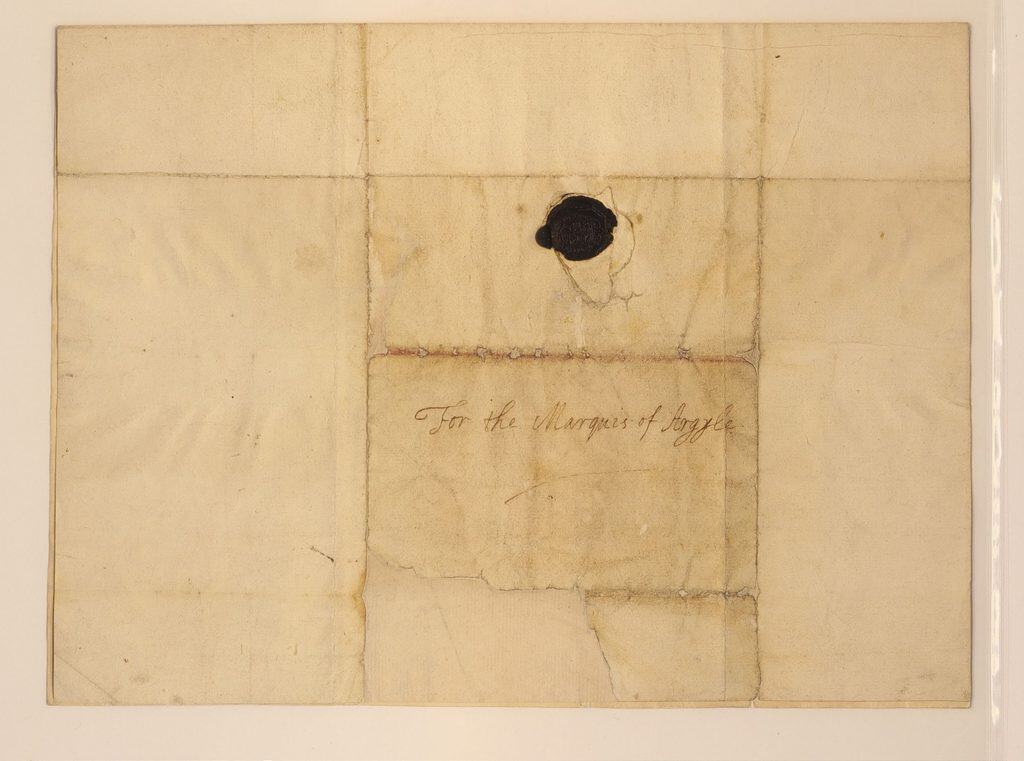
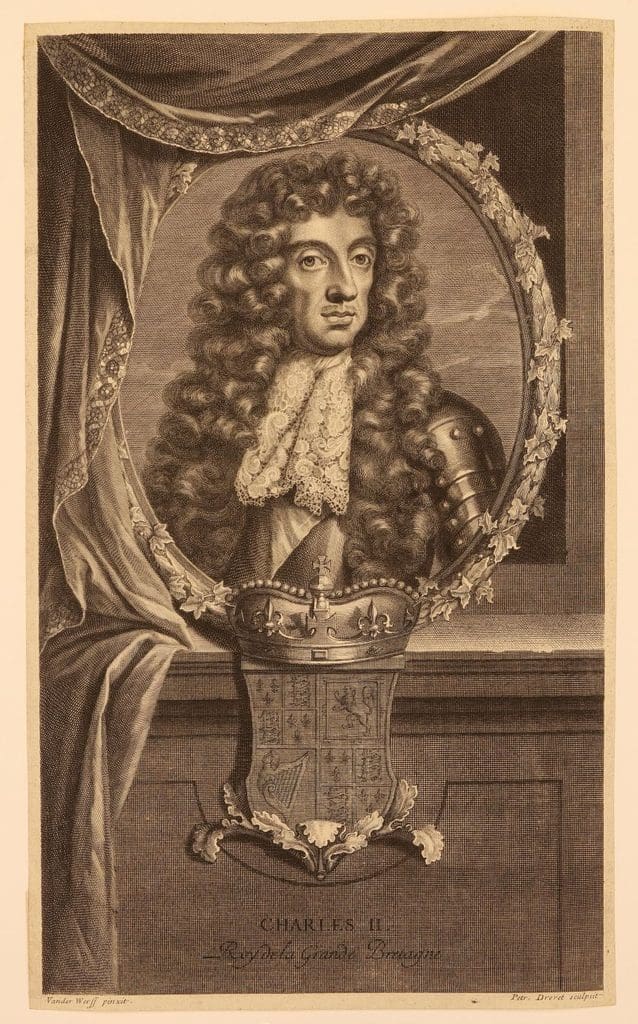
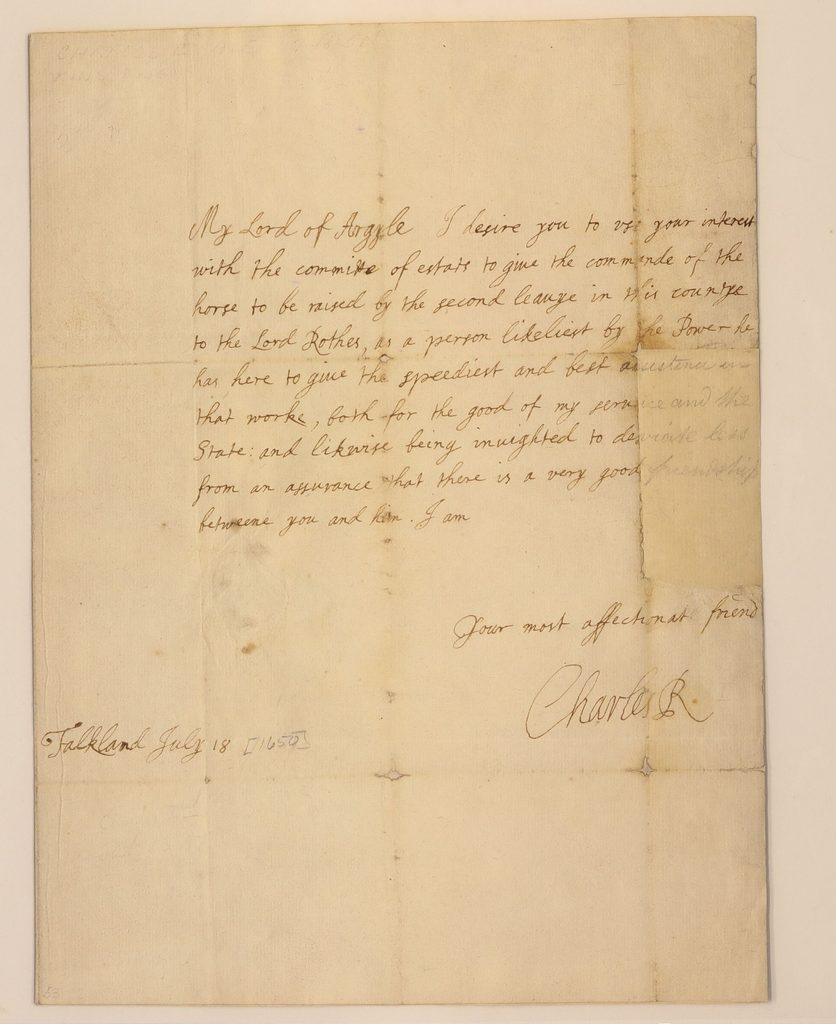
The letter itself shows Charles’ attempts to break out of the proverbial straitjacket that the Covenanters had placed him in. He writes to Argyll and prevails upon him to use his influence to ensure that a cavalry regiment which was intended to be raised in anticipation of an English invasion be placed under the command of John Leslie, Earl of Rothes. Rothes was a supporter of Charles whose career had begun as a Covenanter but who pivoted to Royal service after 1650. In the Restoration regime he was one of the strongest supporters of the Stuart dynasty.[3] Here we see the beginnings of that relationship, as Charles attempts to get his supporters into prominent positions in the Scottish army. The archive already holds another letter, dated the same day, in which Charles complains to Argyll that the Earl of Eglington had been struggling to find men for a new Guard regiment for the King; Charles claims Eglington’s difficulties stemmed from the intransigence of the Covenanters, and that Argyll should use his considerable influence with them to remedy this situation to the King’s liking. Once again we see Charles’ attempts to build up a base of support for himself in the army, using Argyll as a facilitator.
Just four days after this letter was written Oliver Cromwell invaded Scotland at the head of the English New Model Army. He inflicted a crushing defeat on the Scots at the Battle of Dunbar on the 3rd of September 1650. Following this, Argyll was forced to become more receptive to Charles’ demands, even placing the crown on his head at his coronation at Scone on 1st of January 1651. Ultimately, Charles’ reign in Scotland ended in disaster at the Battle of Worcester after which he fled into exile. Argyll reconciled with the Cromwellian military regime which gradually took full control of Scotland. In 1660, the Restoration saw Charles returned to power in all three of his kingdoms, and Argyll was executed as a traitor. Some historians have regarded the execution as little better than judicial murder, driven by a personal vendetta on the part of the King.[4] A vendetta which likely had its roots in this period when Charles was relying on Argyll and assuring him that he was his “most affectionat friend”.
Below is a transcript of the letter.
My Lord of Argyle, I desire to use your interest
with the committee of estats to give the commande of the horse
to be raised by the second leavye in this countrye
to the Lord Rothes, as a person likeliest by the power he
has here to give the speediest and best assistance in
that worke, both for the good of my service and the
state: and likwise being invighted to deviate less
from an assurance that there is a very good friendship
between you and him. I am
Your most affectionat friend
Charles R
Falkland July 18 [1650]
[1] Ronald Hutton, Charles the Second, King of England, Scotland, and Ireland, (Oxford: Oxford University Press, 1991), 49-70.
[2] Allan I. MacInnes, The British Confederate: Archibald Campbell, Marquess of Argyll 1607 – 1661, (Edinburgh, John Donald, 2011), 18.
[3] Gillian H. Mackintosh (2004, September 23). Leslie, John, duke of Rothes (c. 1630–1681), politician and nobleman. Oxford Dictionary of National Biography. Retrieved 3 Nov. 2026, from https://www.oxforddnb.com/view/10.1093/ref:odnb/9780198614128.001.0001/odnb-9780198614128-e-16495.
[4] Macinnes, British Confederate, 386.